
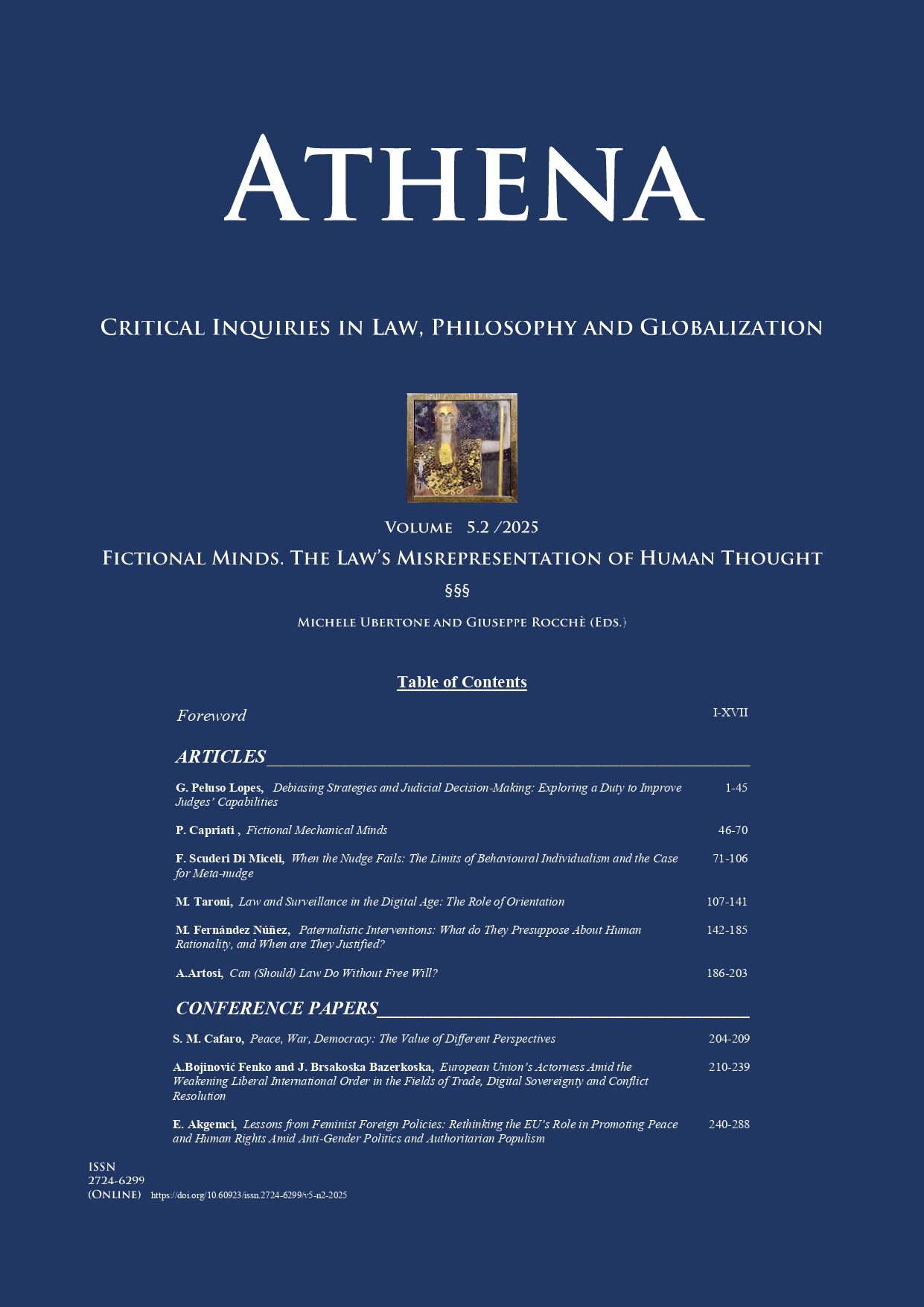
Fictional Mechanical Minds
On the Relationship Between Assumptions of Rationality and Conceptions of Government
DOI:
https://doi.org/10.60923/issn.2724-6299/22550Keywords:
rationality, political legitimacy, decision-making process, aggregative democracy, deliberative democracy, machine-governmentAbstract
If a machine were considered more rational than any other agent, would we entrust it with the government of public affairs? This paper aims to examine the relationship between rationality and political justification. The thesis whose soundness I will verify is: (T1) Depending on which subject’s (greater) rationality is assumed, different conceptions of government emerge. The link between assumptions of rationality and political legitimacy implies another thesis: (T) Under certain conditions, to legitimize a subject to decide on matters of collective interest, it is necessary to assume that the deciding subject is rational. Firstly, the terms of the issue must be clarified: (1) the subjects who confer legitimacy on a government; (2) the assumptions of rationality; (3) rationality; (4) the decision-making subjects; (5) machines as decision-making subjects; (6) the conceptions of government. Secondly, under what conditions do the assumptions of rationality become essential to legitimize a government’s decision on matters of public interest? Finally, starting from three distinct political subjects – (A) the individuals, (B) the individuals conceived as a collective, and (C) the machine – it will be shown how, by assuming their rationality, three distinct conceptions of government take shape that are: (A1) aggregative democracy; (B1) de-liberative democracy; (C1) machine-government.
Downloads
References
Bächtiger A., Dryzek J. S., Mansbridge J. and Warren M. (2018). Deliberative Democracy: An Introduction, in A. Bächtiger, J. S. Dryzek, J. Mansbridge and M. Warren (eds.), The Oxford Handbook of Deliberative Democracy (Oxford University Press), 1-31.
Beetham D. (1991). The Legitimation of Power (Palgrave).
Bohman J. (1998). Survey article: The coming of age of deliberative democracy, in Journal of Political Philosophy, n. 6(4), 400-425.
Capriati P. (2024). Macchine che decidono: prospettive di automazione dei processi decisionali in contesti democratici, PhD thesis, University of Palermo.
Commoner B. (1965). Biochemical, Biological and Atmospheric Evolution, in Proceedings of the National Academy of Science, n. 53, 1183-1194.
Danaher J. (2016). The threat of algocracy: Reality, resistance and accommodation, in Philosophy & Technology, n. 29(3), 245-268.
Elster J. (1986). The Market and The Forum: Three Varieties of Political Theory, in J. Elster and A. Hylland (eds.), Foundations of Social Choice Theory (Cambridge University Press), 103-132.
Habermas J. (1987). The Theory of Communicative Action (Vol. 1) (Beacon Press).
Habermas J. (2015). Between Facts and Norms: Contributions to a Discourse Theory of Law and Democracy (John Wiley & Sons).
Kahneman D. (1994). New Challenges to the Rationality Assumption, in Journal of Institutional and Theoretical Economics.
Kahneman D. (2011). Thinking, Fast and Slow (Penguin).
Kolodny N. and Brunero J. (2013). Instrumental rationality, in Stanford Encyclopedia of Philosophy.
Maturana H. R. and Varela F. J. (2012). Autopoiesis and Cognition: The Realization of the Living (Vol. 42) (Springer Science & Business Media).
Mercier H. (2020). Not Born Yesterday: The Science of Who We Trust and What We Believe (Princeton University Press).
Mercier H. and Sperber D. (2011). Why Do Humans Reason? Arguments for an Argumentative Theory, in Behavioral and Brain Sciences, n. 34.
Mercier H. and Sperber D. (2017). The Enigma of Reason (Harvard University Press).
Moore C. W. (1987). The caucus: Private meetings that promote settlement, in Mediation Q., n. 87.
Penrose R. (1991). The emperor’s new mind, in RSA Journal, n. 139(5420), pp. 506-514.
Russell S. J. and Norvig P. (2016). Artificial Intelligence: A Modern Approach (Pearson).
Smithers T. and Moreno A. (1994) (Eds). Notes for the Workshop on the Role of Dynamics and Representation in Adaptive Behaviour and Cognition, 9 and 10 December, Palacio de Miramar, San Sebastian (Spain).
Smithers T. (1997). Autonomy in Robots and Other Agents, in Brain and Cognition, n. 34(1), pp. 88-106.
Steels L. (1995). When are Robots Intelligent Autonomous Agents?, in Robotics and Autonomous Systems, n. 15(1-2), pp. 3-9.
Stich S. P. (1990). The Fragmentation of Reason: Preface to a Pragmatic Theory of Cognitive Evaluation (MIT Press).
Sunstein C. R. (2002). The Law of Group Polarization, in The Journal of Political Philosophy, n. 10 (2), pp. 175-195.
Tessler M. H., Bakker M. A., Jarrett D., Sheahan H., Chadwick M. J., Koster R., ... and Summerfield C. (2024). AI can help humans find common ground in democratic deliberation, in Science, n. 386(6719), eadq2852.
Thaler R., and Sunstein C. R. (2008). Nudge: Improving Decisions about Health, Wealth and Happiness (Yale University Press).
Turing A. M. (1950). Computing Machinery and Intelligence, in Mind, n. 59, pp. 433-460.
Weber M. (1964). The Theory of Social and Economic Organization (Simon and Schuster).
Weber M. (1978). Economy and society: An outline of interpretive sociology (University of California Press).
Downloads
Published
How to Cite
Issue
Section
License
Copyright (c) 2025 Paolo Capriati

This work is licensed under a Creative Commons Attribution 4.0 International License.