
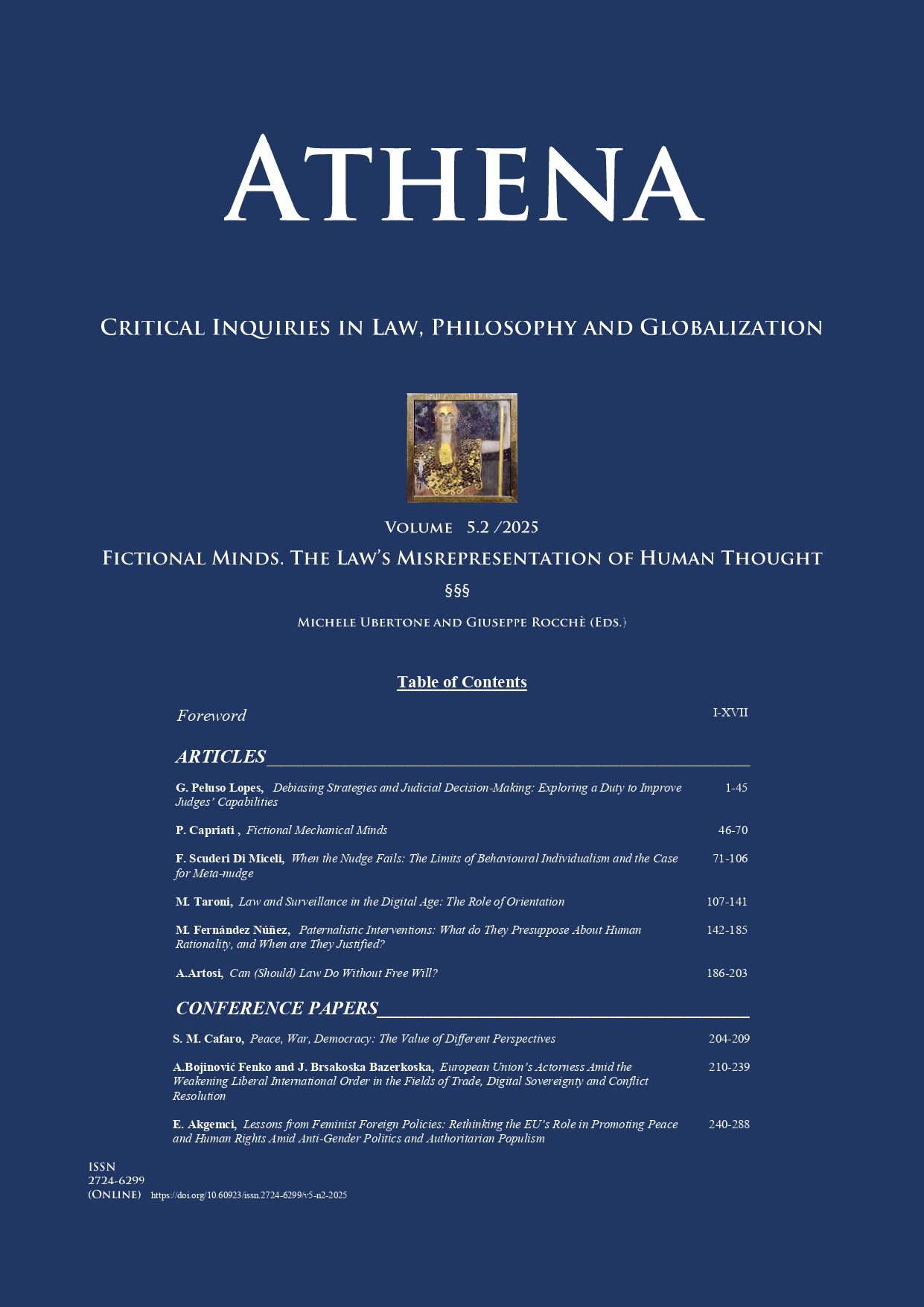
When the Nudge Fails: The Limits of Behavioural Individualism and the Case for Meta-nudge
DOI:
https://doi.org/10.60923/issn.2724-6299/22516Keywords:
nudge, normativity and behaviour, influence, behavioural public policy, meta-nudgeAbstract
This paper explores the limits of behavioural public policy by critically addressing the debate between i-frame and s-frame approaches. It challenges the dichotomy that frames nudges as tools exclusively aimed at individual decision-making (i-frame), while structural reforms are seen as systemic interventions (s-frame). Drawing on Bobbio’s functional taxonomy of legal measures and recent literature on meta-nudges and choice infrastructures, the paper argues that certain behavioural interventions — especially those targeting public officials or institutional processes — can produce systemic effects. Through the example of the “principle of trust” in the Italian Public Contracts Code, the analysis illustrates how regulatory nudges can transform administrative behaviour and reshape decision-making contexts. The aim is to develop a more integrated understanding of behavioural regulation, one that accounts for the interaction between interventions and the social, legal, and institutional environment in which they operate.
Downloads
References
Baldwin R. (2014). From regulation to behaviour change: giving nudge the third degree, The Modern Law Review, vol. 77, n. 6.
Bicchieri C. and Dimant E. (2022). Nudging with care: the risks and benefits of social information, in Public Choice, n. 191.
Bobbio N. (2007). Dalla struttura alla funzione. Nuovi studi di teoria del diritto (Laterza).
Brigaglia M. (2019). Potere. Una rilettura di Michel Foucault (Editoriale Scientifica).
Carloni E. (2024). Verso il paradigma fiduciario? Il principio di fiducia nel nuovo Codice dei contratti e le sue implicazioni, in Diritto pubblico, n. 1.
Chater N. and Loewenstein G. (2023). The i-frame and the s-frame: How focusing on individual-level solutions has led behavioral public policy astray, in Behavioral and Brain Sciences, n. 46.
Congiu L. and Moscati I. (2022). A review of nudges: Definitions, justifications, effectiveness, in Journal of Economic Surveys, n. 36.
Connolly D. J., Loewenstein G. and Chater N. (2024). An s-frame agenda for behavioral public policy research, in Behavioural Public Policy, first view.
Crozier M. (1969). Il fenomeno burocratico (Etas Kompas).
DellaVigna S. and Linos E. (2022). RCTs to Scale: Comprehensive Evidence from Two Nudge Units, in Econometrica, vol 90, n. 1.
Dimant E. and Shalvi S. (2022). Meta-nudging honesty: Past, present, and future of the research frontier, in Current Opinion in Psychology, n. 47.
Duflo E. (2017). The economist as plumber, in American Economic Review, vol. 107, n. 5.
Foucault M. (2004). Sécurité, territoire, population. Cours au Collège de France (1977-1978) (Seuil-Gallimard).
Gelfand S. D. (2023). Nudging, Bullshitting, and the Meta-Nudge, in Cambridge Quarterly of Healthcare Ethics, vol. 32, n. 1.
Gigerenzer G. (2000). Adaptive Thinking: Rationality in the Real World (Oxford University Press).
Galletti G. and Vida S. (2018). Libertà vigilata. Una critica del paternalismo libertario (IF Press).
Hansen P. G. (2016). The Definition of Nudge and Libertarian Paternalism: Does the Hand Fit the Glove?, in European Journal of Risk Regulation, vol. 7, n. 1.
Hansen P. G. and Jespersen A. M. (2013). Nudge and the Manipulation of Choice: A Framework for the Responsible Use of the Nudge Approach to Behaviour Change in Public Policy, in European Journal of Risk Regulation, vol. 4, n. 1.
Johnson E. J. (2022). The elements of choice: Why the way we decide matters (Simon and Schuster).
Kahneman D. (2012). Thinking, fast and slow (Penguin Books).
Kahneman D., Knetsch J. L. and Thaler R. H. (1991). Anomalies: The Endowment Effect, Loss Aversion, and Status Quo Bias, in Journal of Economic Perspectives, vol. 5, n. 1.
Liebe U., Gewinner J. and Diekmann A. (2021). Behavioral interventions and climate change: A meta-analysis, in Ecological Economics, n. 185.
Luo Y., Li A., Soman D. and Zhao J. (2023). A meta-analytic cognitive framework of nudge and sludge, in Royal Society Open Science, vol. 10, n. 11.
Madva A., Brownstein M. and Kelly D. (2023). It's always both: Changing individuals requires changing systems and changing systems requires changing individuals, in Behavioral and Brain Sciences, n. 46.
Münscher R., Vetter M. and Scheuerle T. (2016). A review and taxonomy of choice architecture techniques, in Journal of Behavioral Decision Making, vol. 29, n. 5.
Schmidt R. (2024). A model for choice infrastructure: looking beyond choice architecture in Behavioral Public Policy, in Behavioural Public Policy, n. 8.
Simon H. A. (1955). A Behavioral Model of Rational Choice, in The Quarterly Journal of Economics, vol. 69, n. 1.
Simon H. A. (1957). Models of Man: Social and Rational (Wiley).
Simon H. A. (1997). Administrative Behavior: A Study of Decision-Making Processes in Administrative Organizations (Simon and Schuster).
Stanovich K. E. and West R. F. (2000). Individual Differences in Reasoning: Implications for the Rationality Debate?, in Behavioral and Brain Sciences, vol. 23, n. 5.
Starke A. D. and Willemsen M. C. (2024). Psychologically Informed Design of Energy Recommender Systems, in B. Ferwerda, M. Graus, P. Germanakos and M. Tkalčič (eds.), A Human-Centered Perspective of Intelligent Personalized Environments and Systems (Springer).
Sunstein C. R. (2021). Sludge: What Stops Us from Getting Things Done and What to Do About It (MIT Press).
Sunstein C. R. (2022). The rhetoric of reaction redux., in Behavioural Public Policy, vol. 7, n. 3.
Sunstein C. R. (2023). Conspiracy theory, in Behavioral and Brain Sciences, n. 46.
Thaler R. H. (2023). Nudging is being framed, in Behavioral and Brain Sciences, n. 46.
Thaler R. H. and Sunstein C. R. (2008). Nudge: Improving Decisions About Health, Wealth, and Happiness (Penguin).
Thaler R. H. and Sunstein C. R. (2021). Nudge: The Final Edition (Yale University Press).
Thaler R. H., Sunstein C. R. and Balz, J. P. (2014). Choice architecture, in E. Shafir (ed.), The Behavioral Foundations of Public Policy (Princeton University Press).
Tuzet G. (2016). Effettività, efficacia, efficienza, in Materiali per una storia della cultura giuridica, n. 1.
Ursi R. (2024). La ‘trappola della fiducia’ nel Codice dei contratti pubblici, in Bilancio comunità persona, n. 1.
Valta M. and Maier C. (2025). Digital Nudging: A Systematic Literature Review, Taxonomy, and Future Research Directions, in SIGMIS Database, vol. 56, n. 1.
Zito A. (2021). La nudge regulation nella teoria giuridica dell’agire amministrativo. Presupposti e limiti del suo utilizzo da parte delle pubbliche amministrazioni (Editoriale Scientifica).
Downloads
Published
How to Cite
Issue
Section
License
Copyright (c) 2025 Flavio Scuderi Di Miceli

This work is licensed under a Creative Commons Attribution 4.0 International License.